




How Much Does It Cost to Build a Website for a Small Business?
Here is the honest answer up front: most small business websites cost somewhere between $1,000 and $10,000 for a professional build, or roughly $150 to $500 a month on a subscription model. But that range is so wide it is almost useless on its own, because what you actually pay depends entirely on who builds it, how it is built, and what is included. More importantly, the cheapest option often ends up being the most expensive one in the long run, and I have watched that play out firsthand right here in Tampa.
Let's break down what you are really paying for so you can make an educated decision instead of just chasing the lowest number.
The Four Ways to Get a Website, and What Each Costs
There are essentially four routes a small business can take. Each comes with a very different price tag and a very different result.
Option 1: DIY Website Builders
Platforms like Wix, Squarespace, and GoDaddy let you build the site yourself. Wix runs about $16 to $45 a month, Squarespace around $16 to $40, and GoDaddy roughly $10 to $20.
On paper this looks like the obvious budget choice. The catch is that you are the one building it, which means the real cost is your time, and the result is a template that looks like every other business using the same platform. These sites also tend to carry bloated code that hurts your speed and your search rankings. For a business just testing the waters, a builder can work. For a service business trying to compete locally, it usually falls short.
Option 2: Hiring a Freelancer
A freelance web designer typically charges between $500 and $5,000 for a one-time build, depending on their experience. Junior freelancers sit at the low end, seasoned ones at the high end.
Freelancers can be a solid middle ground. You get a custom site and direct communication. The downside is that quality varies wildly, and once the site is built, ongoing support is often limited or nonexistent. If your freelancer moves on or gets busy, you can be left stranded when something breaks.
Option 3: A Traditional Agency
This is where prices climb fast. A traditional agency will usually charge anywhere from $3,000 to $15,000 or more upfront for a small business site, plus ongoing monthly maintenance fees on top.
You are paying for a team, a process, and a polished result. But you are also paying for their overhead, and small local businesses often get lost as the least important client on a big agency's roster. This is also where the horror stories tend to come from, and I want to tell you about one.
A Real Tampa Example: The $36,000 Invisible Website
A colleague of mine owns a roofing company here in Tampa. When he first set up his website, he went with a provider who charged him $15,000 upfront and then $1,500 every single month for what was described as maintenance.
At first he was happy. The site looked professional and he felt like he had invested in doing things right. But months went by and the website did nothing for him. No calls. Not a trickle. For $1,500 a month, that maintenance fee covered hosting and basic upkeep, and that was about it. There was no local SEO, no on-page SEO, no sitemap submission, none of the actual work that makes a website findable. So while he was paying premium prices, his business was effectively invisible online. Anyone in Tampa searching for a roofer was finding his competitors instead of him.
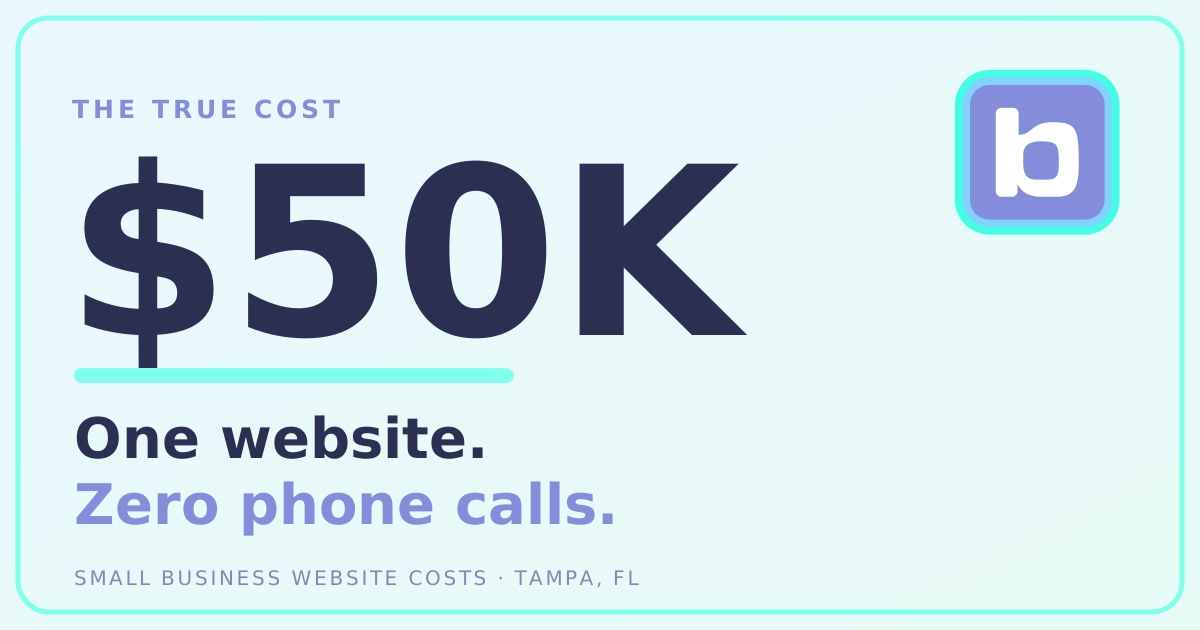
Do the math on that. $1,500 a month for two years is $36,000, on top of the original $15,000. More than $50,000 total, for a website that generated zero phone calls.
Getting out was not simple either. Leaving the provider meant untangling who actually owned what, figuring out how to move the site, and taking on the technical side himself with no background in it. He eventually managed to keep his website's code and now self-hosts it on his own. He did see a modest uptick in calls afterward, mostly because he was no longer buried under a provider doing nothing, but here is the part that matters: the site is still essentially static. It sits there. No ongoing SEO, no on-page optimization, no fresh content, no sitemap work. All the things that were missing when he was paying $1,500 a month are still missing now, because those things take real, consistent effort and he is a roofer, not an SEO expert.
He will be the first to tell you self-hosting is a constant bit of extra work piled on top of actually running a roofing business, and it is not the right path for most owners. He escaped the worst of it, but his website still is not doing what a website is supposed to do. It is just no longer actively costing him $1,500 a month to stay invisible.
That story is the whole reason this post exists. The price you pay tells you almost nothing about the value you get, and even getting out of a bad situation does not automatically put you in a good one.
Option 4: The Subscription Model
The newest approach bundles everything into one predictable monthly payment, usually somewhere between $150 and $500 a month, with no large upfront cost. This typically covers design, hosting, maintenance, support, and depending on the plan, the ongoing SEO work that my roofing colleague was missing.
The subscription model exists specifically to solve the two biggest problems with the other options: the huge upfront cost of an agency and the abandonment that happens after a freelancer or agency cashes the check. If you want a deeper look at how this works, I broke it down fully in a separate post on whether a monthly website subscription is worth it. The short version is that for a lot of small businesses, spreading the cost out while keeping the site actively maintained is the difference between a website that works and one that just sits there.
What Actually Drives the Cost Up or Down
Regardless of which route you choose, a handful of factors determine where you land in the price range.
The number of pages is the biggest one. A five-page site costs far less than a fifteen-page site, and most providers charge per additional page beyond a base number. Custom design versus a template is another major factor, since custom work takes more time and skill. Special functionality like booking systems, e-commerce, or customer logins adds cost quickly. And ongoing services like SEO, content, and maintenance are what separate a site that merely exists from one that actively brings in business.
That last point is the one Tampa business owners get wrong most often. They budget for the build and forget that a website with no ongoing SEO is like a billboard in the desert. It technically exists, but nobody sees it.
Why Cheapest Is Rarely Cheapest in a Competitive Market
Tampa Bay is a crowded market. Whether you are a roofer, a plumber, an HVAC company, or a cleaning service, you are competing against dozens of other local businesses for the same customers, and most of those customers are finding you through Google.
I spent five years in the Tampa Bay HVAC industry before this, so I know exactly how competitive it is to win a local service customer. When someone's air conditioner dies in July, they pull out their phone, search, and call one of the first businesses they see. If your website is slow, invisible, or built on a cheap template that Google ignores, you are not in that consideration set at all. It does not matter how good your actual work is if nobody can find you.
This is why the cheapest website usually costs the most. A $16-a-month builder site that brings in zero leads is infinitely more expensive than a well-built site that brings in even one new customer a month. The price of the website matters far less than whether it actually does its job.
So What Should You Actually Budget?
For a Tampa Bay service business that genuinely wants to compete online, expect to invest either a few thousand dollars upfront for a quality custom build, or a few hundred dollars a month on a subscription model that keeps the site maintained and optimized over time.
What you want to avoid is the worst of both worlds: paying premium prices for a site that nobody maintains in the ways that matter. That is the trap my roofing colleague fell into. It cost him more than $50,000 and two years of invisibility, and even now, after getting out, his site still is not doing the work that actually brings in customers.
Because here is the real lesson underneath his whole story: getting the website was never the point. A website is not a thing you buy once and check off the list. The build is just the starting line. The ongoing work, the SEO, the optimization, the content, the maintenance, is what actually brings in customers. Skip that part and it does not matter whether you paid $16 a month or $50,000, because either way you end up with a site that just sits there.
The right question is not "what is the cheapest website I can get." It is "what will actually get my business found and bring in customers." Answer that one, and the cost takes care of itself.
Want a Straight Answer on What Your Site Would Cost?
At Bay Breeze Web Studio, our pricing is simple and transparent, with no large upfront cost and everything you need to actually get found bundled into one monthly rate. You can see exactly what is included on our website plans page. If you would rather just talk it through, reach out and I will give you an honest answer about what makes sense for your business.